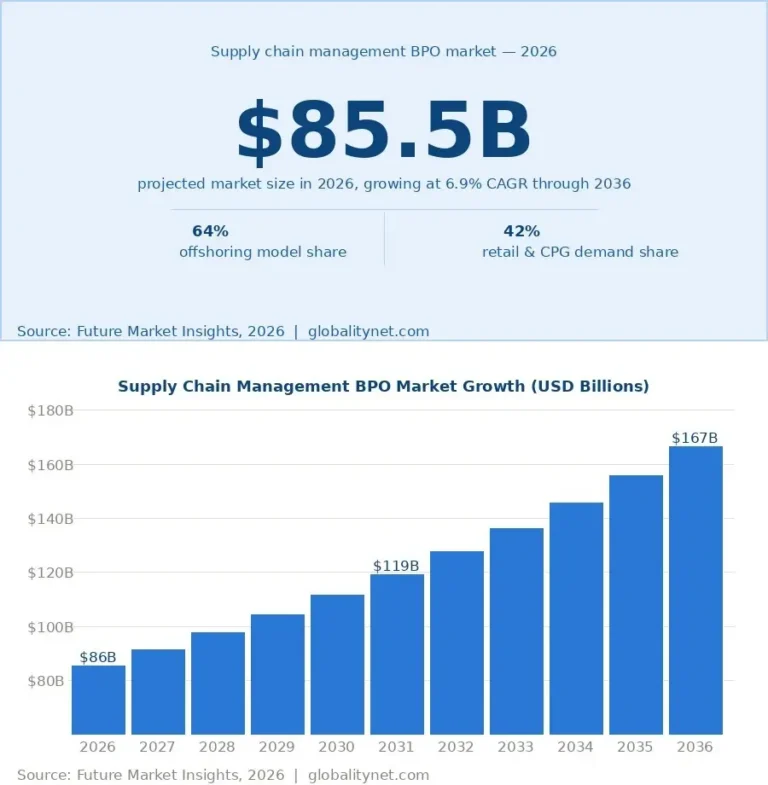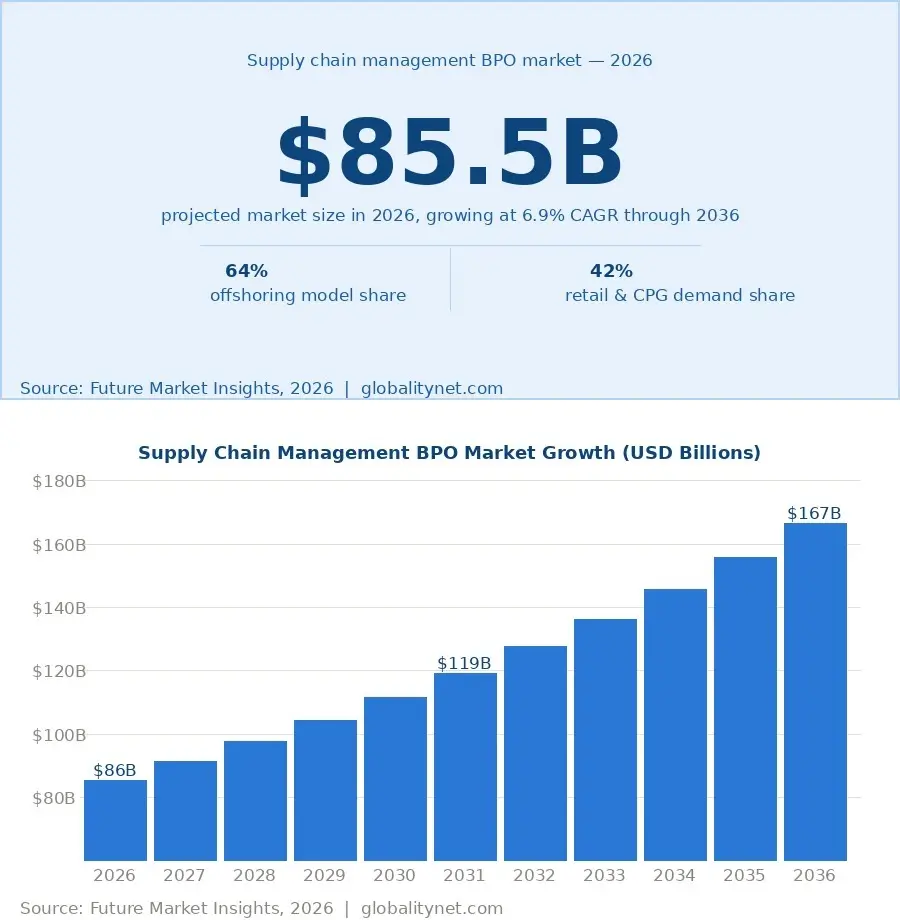
The supply chain BPO market is projected to hit $85.5 billion in 2026, growing at nearly 7% annually through 2036. That number doesn’t happen by accident.
For years, outsourcing meant one thing to most companies: cut costs, move headcount offshore, repeat. What’s changed is what companies are actually handing off — and the level of ownership they’re expecting in return.
This isn’t a back-office trend anymore. Manufacturers, distributors, and wholesalers are outsourcing core supply chain functions — the kind of work that used to live exclusively on the org chart of a VP or Director. And the reason it’s gaining traction has less to do with cost and more to do with bandwidth, speed, and the reality that building and retaining specialized supply chain talent in-house is expensive and slow.
Here’s a practical look at what’s moving.
What’s Actually Getting Outsourced
Procurement Support and Vendor Management
Procurement is one of the fastest-growing areas of supply chain BPO. Companies are outsourcing purchase order execution, supplier follow-up, vendor scorecards, and sourcing coordination — not because procurement strategy is going offshore, but because the operational execution behind it is time-consuming and repeatable.
A dedicated offshore team can own the day-to-day supplier communication, track commitments, flag deviations, and feed clean data back to the internal team. That frees up your internal procurement leader to focus on negotiations and sourcing strategy rather than chasing POs.
Demand Planning and Inventory Tracking
Demand planning support is increasingly being outsourced, particularly the data compilation, reporting, and exception flagging that feeds into S&OP cycles. When your internal team is spending half their week pulling data from ERP systems and building spreadsheets, that’s time not spent analyzing the data and making decisions.
Inventory tracking and reconciliation — especially in multi-location environments — is another area where offshore teams are adding real value. The work is structured, data-intensive, and doesn’t require someone physically on-site.
Order Management and Logistics Coordination
Order management, from order entry through fulfillment confirmation, is one of the cleaner functions to transition to an offshore team. The workflows are defined, the systems are established, and with the right onboarding, an offshore team can own the function with minimal daily oversight.
Logistics coordination — carrier communication, freight bill processing, shipment tracking, exception management — follows the same logic. It’s high-volume, time-sensitive work that doesn’t have to sit in a U.S. time zone to get done.
Supplier Communication and Trade Compliance
Trade compliance support has become a growing area of supply chain outsourcing in 2026, particularly as companies navigate layered tariff environments, forced labor reporting requirements, and supplier documentation. The research, documentation, and compliance tracking work can be handled by a well-trained offshore team that understands the regulatory framework and keeps the data current.
Supplier communication — status updates, document requests, performance data collection — is also moving offshore. It’s not strategic, but it’s constant, and when it doesn’t get done, things fall through the cracks.
Data Analytics and Reporting
This one surprises people. The assumption is that analytics requires a senior analyst in-house. In practice, a lot of what companies call “analytics” is data pulling, formatting, and report building — structured work that a trained analyst can handle remotely and deliver on a regular cadence.
The more sophisticated analytical work — building models, interpreting trends, making recommendations — still sits internally. But the operational data work underneath it doesn’t have to.
Why This Is Working Now
A few things are driving the shift beyond the obvious cost argument.
The talent market is tight. Finding and keeping experienced supply chain professionals at the manager and analyst level is genuinely hard right now. Outsourcing some of those functions gives companies coverage without the recruiting cycle and overhead.
The work has become more structured. ERP systems, WMS platforms, and cloud-based tools mean that a well-trained offshore team working in your systems, on your hours, can execute with the same visibility as someone sitting in your building. The friction that used to make offshore supply chain work difficult has come down significantly.
The offshoring model is winning. Among companies using supply chain BPO, 64% are using an offshoring model. The Philippines specifically has become a major delivery location for these functions — not just because of cost, but because of English fluency, cultural alignment with U.S. business practices, and the ability to work on U.S. business hours full-time.
What This Doesn’t Mean
Outsourcing supply chain functions doesn’t mean handing off accountability. The companies seeing the best results treat their offshore team as an extension of their internal operation — with real onboarding, clear SOPs, defined KPIs, and a point of contact who manages the relationship with actual attention.
The ones who struggle are the ones who treat it like a transaction. They hand off a list of tasks, skip the knowledge transfer, and wonder why quality is inconsistent three months in.
The work structure also matters. Not every function is ready to outsource on day one. If your internal processes are fragmented or your data is unreliable, those problems don’t go away when you move the work offshore — they show up faster and in higher volume. Getting your own house in order before you transition work is a prerequisite, not a suggestion.
The Bottom Line
The supply chain BPO market is growing because the underlying economics make sense — when it’s done right. Companies that are winning with outsourced supply chain teams are doing it with structure, not as a shortcut.
If you’re a manufacturer, distributor, or wholesaler evaluating which functions could move offshore, the starting point is honest: where is your team spending time on work that’s structured, repeatable, and doesn’t require someone in your building? That’s where the conversation starts.
At GlobalityNet, we build offshore supply chain teams for manufacturers, distributors, and wholesalers — from procurement support and demand planning to logistics coordination, analytics, and back-office operations. Our teams work U.S. business hours, inside your systems, with the kind of accountability your internal team expects.